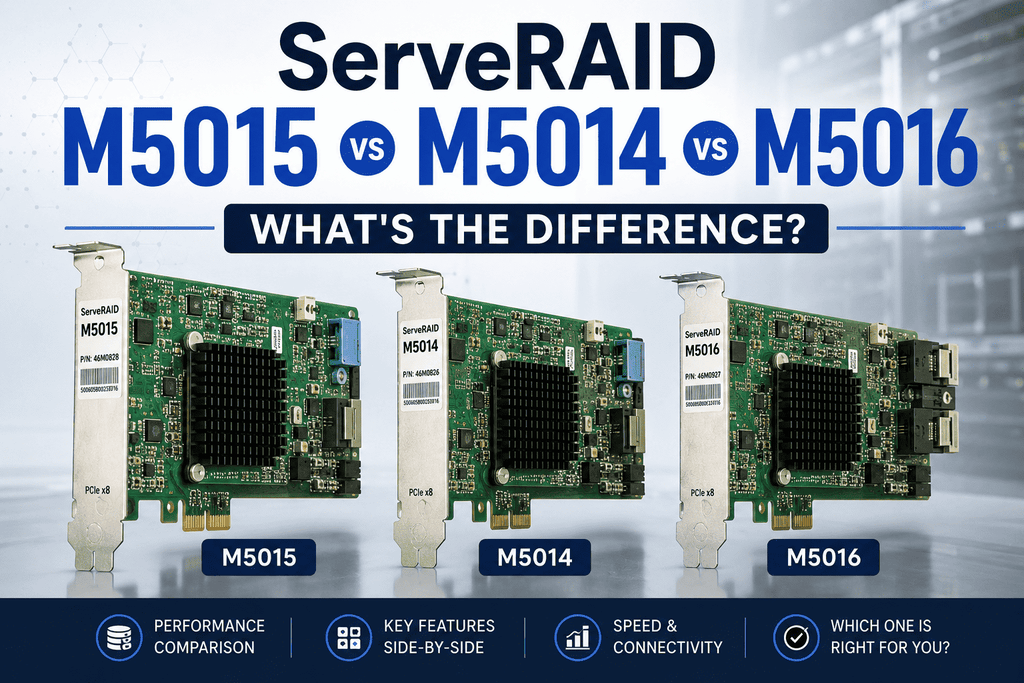
ServeRAID M5015 vs M5014 vs M5016: What's the Difference?
If you're shopping for a used or refurbished IBM ServeRAID controller for a System x server, you've probably run into three very similar-looking model numbers: the M5014, M5015, and M5016. They share a lot of DNA — same form factor, same connector layout, same general use case — but the differences between them matter a lot depending on your workload and what kind of cache protection you need. Here's a breakdown to help you pick the right one.
The Short Answer
All three are 6 Gbps SAS/SATA RAID controllers built for IBM System x servers, but they differ mainly in cache size, cache protection method, and processing power:
- M5014 – Entry-level, smallest cache, no standard battery
- M5015 – Mid-tier, larger cache, includes a standard battery backup unit (BBU)
- M5016 – Highest performance, dual-core processor, uses capacitor-based flash cache protection instead of a battery
ServeRAID M5014: The Entry-Level Option
The M5014 is a 6 Gbps SAS 2.0 RAID controller including 256 MB of cache and an optional battery instead of a conventional one. It utilizes the similar LSI SAS2108 RAID-on-Chip (ROC) as the M5015, meaning the foundational silicon is the same — the M5014 is fundamentally a more economical version of the same architecture.
Good for: Basic internal RAID setups (RAID 0, 1, 5, 10) where you don't need battery-backed write cache, or budget-conscious builds where cache protection isn't a priority.
ServeRAID M5015: The Balanced Mid-Tier Card
The M5015 offers enhanced performance benefits compared to the M5014 due to its larger cache and a standard battery backup system. Similar to the M5014, it is constructed on the LSI SAS2108 ROC and accommodates identical RAID configurations; nevertheless, the enhanced cache and integrated BBU render it a superior option for production tasks that require write-back caching to endure a power failure.
The M5015 is equipped with 512 MB of cache and includes a standard battery backup unit when purchased with the appropriate option part number. The M5014 and M5015 can be enhanced with the ServeRAID M5000 Series Advanced Feature Key to enable RAID 6, RAID 60, and self-encrypting disk (SED) key management.
Suitable for: Versatile servers handling write-intensive tasks (databases, file servers, virtualization hosts) where the investment in write-back cache with battery protection justifies the additional expense compared to the M5014.
ServeRAID M5016: The Performance Upgrade
The M5016 represents an advancement in an alternative trajectory. It is constructed on the LSI SAS2208 ROC, including a rapid dual-core 800 MHz PowerPC CPU, complemented by a complete 1 GB of DDR3 cache operating at 1333 MHz, interfaced via a PCI Express x8 Gen 2 host connection. This configuration possesses double the cache of the M5015 and about quadruples that of the M5014, in addition to providing significantly greater processing capacity for RAID parity computations.
The primary architectural distinction lies in the manner in which the M5016 safeguards its cache. Rather than employing a lithium-ion battery, it utilizes 1 GB of flash-backed cache integrated with super-capacitor technology, hence obviating the necessity for a disposable battery entirely. This CacheVault-type safeguard employs a supercapacitor to transfer cached information onto NAND flash following a power interruption, instead of maintaining DRAM functionality with battery power indefinitely.
This matters in practice for two reasons:
- Longevity — Capacitors don't degrade the way lithium-ion batteries do, so there's less periodic maintenance and no "learn cycle" battery reconditioning to worry about.
- Data retention — Flash-backed cache retains data indefinitely once written to NAND, whereas a battery-backed DRAM cache only holds data for as long as the battery has charge (typically 24–72 hours).
One practical consideration when purchasing used items: ensure that the capacitor/flash module is indeed present. Certain vendors dispatch the M5016 board devoid of the capacitor and cable, thereby rendering it a cached card lacking any cache backup hence, verify this before to purchase.
Good for: Performance-sensitive or write-intensive workloads where you want maximum cache size, faster RAID processing, and don't want to deal with battery replacement down the line.
Side-by-Side Comparison
| Feature | M5014 | M5015 | M5016 |
|---|---|---|---|
| RAID-on-Chip (ROC) | LSI SAS2108 | LSI SAS2108 | LSI SAS2208 (dual-core) |
| Onboard cache | 256 MB | 512 MB | 1 GB (DDR3-1333) |
| Cache protection | Optional battery | Standard battery (BBU) | Supercapacitor + flash (CacheVault) |
| SAS/SATA ports | 8 (2x SFF-8087) | 8 (2x SFF-8087) | 8 (2x SFF-8087) |
| Throughput | 6 Gbps/port | 6 Gbps/port | 6 Gbps/port |
| RAID levels (base) | 0, 1, 5, 10 | 0, 1, 5, 10 | 0, 1, 5, 6, 10, 50, 60 |
| RAID 6/60 | Requires Advanced Feature Key | Requires Advanced Feature Key | Included |
| Host interface | PCIe x8 | PCIe x8 | PCIe x8 Gen 2 |
Which One Should You Buy?
- On a tight budget and running light RAID workloads? The M5014 is the cheapest entry point, but factor in that it doesn't include a battery standard — you'll want one if you're using write-back cache.
- Need reliable write-back caching for a production server without breaking the bank? The M5015 is the sweet spot — proven hardware, standard BBU included, and RAID 6 available via the feature key.
- Want the best performance and don't want to deal with battery maintenance? The M5016 is the clear upgrade — more cache, a faster dual-core ROC, and capacitor-based protection that doesn't degrade like a battery. Just confirm the CacheVault module is included when buying used.
A Note on Buying Used or Refurbished
All three of these controllers are withdrawn from IBM/Lenovo's active product line, so most units on the market today are pulled from decommissioned servers. When shopping used:
- Confirm whether the battery (M5014/M5015) or capacitor module (M5016) is physically included — it's often sold separately.
- Check the firmware version, since older firmware may need updating for full feature support.
- Verify compatibility with your specific System x server model before purchasing, as supported server lists vary by controller generation.
Have questions about which controller fits your specific server model or workload? Reach out to our team at Beaver Computers — we're happy to help you match the right RAID controller to your build.