Direct Thermal vs Thermal Transfer Printers: How to Choose
When purchasing a label printer for shipping, retail, warehousing, or healthcare, you will encounter this decision almost immediately: thermal transfer or direct thermal? Both technologies employ heat to generate an image; however, they operate in fundamentally distinct manners. Selecting the incorrect technology can result in labels that fail scanners months (or even weeks) after printing, as they fade, smear, or fail. Here is a method for distinguishing between them and selecting the appropriate one for your application.
The Core Difference
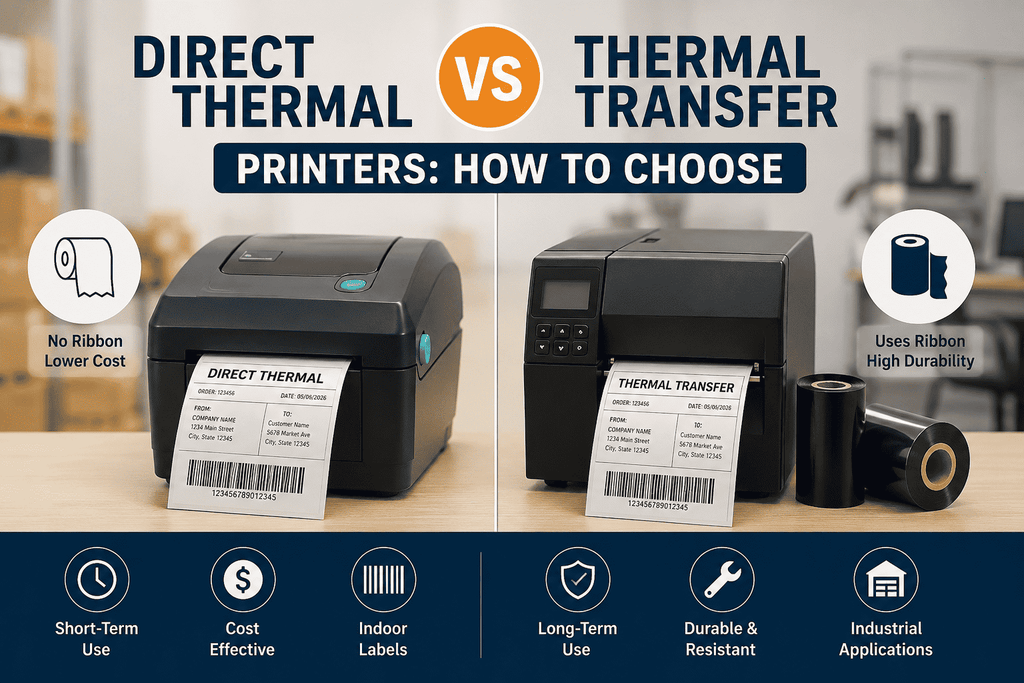
A direct thermal printer generates text or images by directly applying heat to heat-sensitive print material, which reacts to the heat. The paper is chemically coated to produce a darkening effect whenever the printhead contacts it, without the need for ink, toner, or ribbon.
In contrast, thermal transfer printing necessitates a ribbon to generate the image. These printers employ wax or resin-based ink ribbons that melt onto the label. The ink is absorbed into the label, resulting in the image becoming a part of the media rather than remaining on the surface.
The most apparent distinction is the material used: direct thermal is dependent on chemically coated paper, whereas thermal transfer necessitates a ribbon and compatible label media.
Direct Thermal Printing: Pros and Cons
Pros
- Eliminates the necessity for ink filaments, thereby reducing consumable costs in high-volume applications.
- In terms of user knowledge, it's easy to use because there is no ribbon to load or change.
- Low-maintenance, as the presence of fewer moving elements reduces the likelihood of malfunctions.
Cons
- The paper is susceptible to fading when exposed to heat, light, water, or chemicals, which is indicative of its inadequate environmental resistance.
- Labels have a brief lifecycle, with an average lifespan of approximately six months under normal circumstances.
- Subject to wear, given that the label remains chemically active after printing and is prone to surface damage from friction and manipulation.
- Produces solely black prints, which may not satisfy the requirements of all applications.
Thermal Transfer Printing: Pros and Cons
Pros
- When paired with appropriate media, thermal transfer is resistant to heat and moisture, and the image remains intact – rendering it the most resilient printed label alternative accessible.
- The ribbon serves as a safeguarding barrier between the printhead and the label, resulting in reduced direct wear on the printhead and diminished long-term maintenance expenses.
- Visuals and written content endure degradation in direct sunlight significantly more effectively than conventional thermal prints.
- Accommodates a broader range of material types compared to direct thermal, encompassing paper and polypropylene, suitable for both conventional and weather-resistant uses.
Cons
- Ribbons cause interruptions, as alterations and necessary mechanical adjustments disrupt the printing operation.
- Elevated initial expenditure, and ribbons must be substituted periodically to preserve print excellence.
Cost Comparison: It's Not as Simple as "Cheaper Upfront"
One could be inclined to believe that direct thermal is invariably the more economical choice as it eliminates the need for ribbons. In reality, the mathematics is more intricate. Direct thermal labels are often pricier because of their unique heat-sensitive coating, and although omitting the ribbon can lower costs, this may not hold true when considering printhead degradation and the frequency of replacements in high-volume printing. If the label material is rough, direct interaction with the printhead might accelerate its deterioration, increasing maintenance expenses over time – a cost that thermal transfer circumvents as the ribbon serves as a protective barrier.
The right cost comparison depends on your print volume, how long your labels need to stay legible, and how often you're willing to replace consumables versus hardware.
When to Choose Direct Thermal
Direct thermal makes sense when:
- Labels have a short useful life — think shipping labels used within days, or receipts read once and discarded
- You want the simplest possible operation, with no ribbon loading or ribbon inventory to manage
- Labels won't be exposed to significant heat, direct sunlight, or moisture
- <cite index="29-1">You're printing common barcode applications such as shipping labels, receipt labels, and nametag labels</cite>
When to Choose Thermal Transfer
Thermal transfer is the better fit when:
- Labels need to survive for months or years, not days
- Labels will endure severe conditions – heat, sunshine, or chemical exposure, where resilience is essential, particularly in aerospace or medical contexts where legibility must be maintained throughout the product's lifespan.
- You need labels that resist abrasion, smudging, and scanner-readability loss over time
- You're labeling assets, equipment, or inventory that needs a durable, long-term identifier rather than a disposable one
Quick Decision Guide
| If your priority is... | Choose... |
|---|---|
| Lowest upfront hardware complexity | Direct Thermal |
| Labels used and discarded within days/weeks | Direct Thermal |
| Labels that must last 6+ months | Thermal Transfer |
| Outdoor or high-heat/light exposure | Thermal Transfer |
| Long-term asset tracking or compliance labeling | Thermal Transfer |
| Lowest ribbon/consumable management overhead | Direct Thermal |
| Best barcode scan durability over time | Thermal Transfer |
Frequently Asked Questions
Can one printer do both direct thermal and thermal transfer? Many label printers — including popular models like Zebra's ZD420 and ZD620 — support both methods, letting you print direct thermal without a ribbon or switch to thermal transfer for more durable labels as needed. Check the specific printer's specifications, since some entry-level models are direct-thermal only.
How long do direct thermal labels actually last? <cite index="33-1">Direct thermal labels generally shouldn't be used beyond about a six-month timeframe</cite> under normal conditions, though this varies with exposure to heat, light, and handling.
Is thermal transfer overkill for basic shipping labels? For most shipping labels that are scanned and discarded within days of printing, direct thermal is typically sufficient and more cost-effective. Thermal transfer becomes worthwhile when labels need to survive longer transit times, outdoor exposure, or extended warehouse storage.
Do thermal transfer ribbons work with any label material? No — ribbon chemistry (wax, resin, or wax-resin blends) needs to be matched to the label material for best adhesion and durability. Your printer or label supplier can help match ribbon type to your specific label stock.
Printing needs vary by application, volume, and environment. When in doubt, test both label types under your actual working conditions before committing to a printer and consumables strategy at scale.