40GBase-AOC vs Copper DAC Cables: When to Use Each
If you're building out a 40G network fabric, one of the first infrastructure decisions you'll face is cabling: 40GBase Active Optical Cable (AOC) or copper Direct Attach Cable (DAC). Both plug directly into QSFP+ ports with no separate transceiver required, but they behave very differently once you factor in distance, power draw, cost, and rack density. Here's how to choose the right one for your deployment.
What's the Difference?
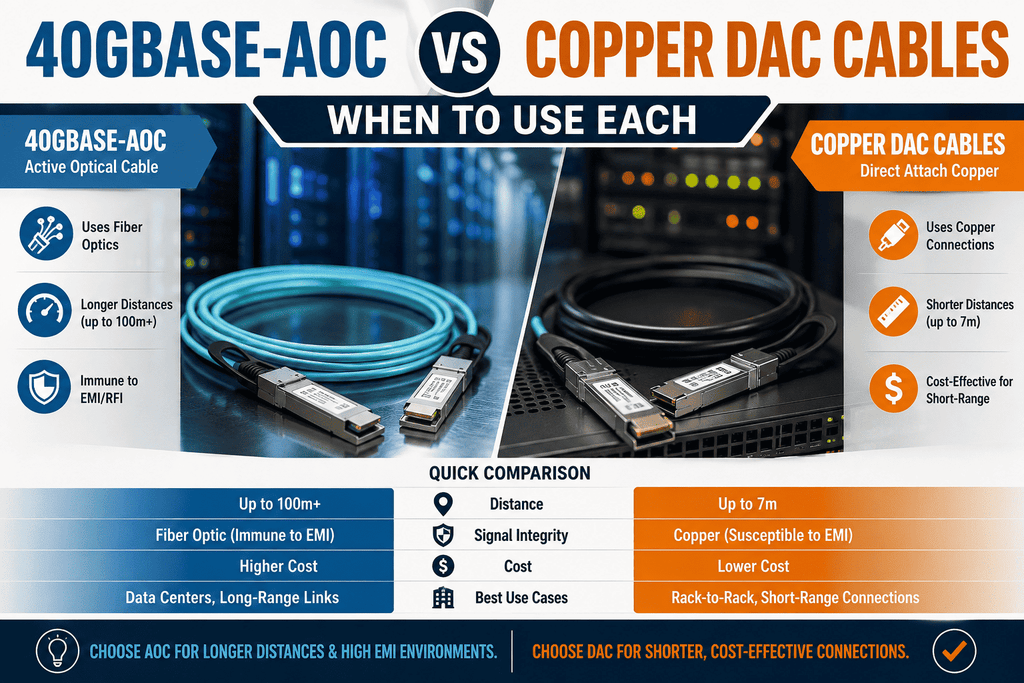
A 40G QSFP+ DAC is a rapid twinaxial cable equipped with QSFP+ connectors on either end, utilizing silver-plated conductors and foam insulation with shielding to convey electrical signals directly thru copper. The transmission route is uncomplicated - electrical signal input, copper wire, electrical signal output — without any visual transformation.
OC cables, in contrast, transform signals from electrical to optical and revert them to electrical, utilizing optical fibers for transmission, with transceivers included at both ends of the cable. The integrated optical engine provides AOC with an extended range; nevertheless, it also increases expenses, power consumption, and introduces an additional active component that may malfunction.
Distance: The Biggest Deciding Factor
Distance is usually what settles the AOC-vs-DAC question before anything else does.
- The permissible length for a DAC cable link is roughly 10 meters, where passive DAC usually has a maximum of around 7 meters and active DAC can extend to about 10 meters, however the attainable distance reduces with higher data transfer rates. AOC cables offer longer transmission distances than the roughly 10-meter limit of DAC cables, and Cisco's 40GBase-AOC lineup, for example, includes cables running up to 15 meters with some vendors' broader AOC catalogs extending well beyond that.
Rule of thumb: If your connection is situated within a rack or between closely positioned racks, DAC typically prevails. When extending your reach – across a row, to an alternate rack, or thru extensive cable trays ,AOC becomes essential or significantly more feasible.
Power Consumption and Latency
Since DAC conveys electrical signals over copper without employing lasers or optical conversion, it eliminates the components that inflate AOC's expenses, and its more straightforward signal pathway also diminishes delay. The power consumption of passive DAC is nearly negligible, much below 0.15W, whereas active DAC generally consumes less than 1W.
AOC, conversely, requires energy to operate its integrated optics at both terminals. AOC cables typically utilize more power than DAC, usually within the 1–2W spectrum. While it may appear insignificant on a per-cable basis, the cumulative effect of 1–2 watts over thousands of cables in a substantial facility significantly alters the total power consumption of the establishment.
For applications sensitive to latency such as high-frequency trading, closely integrated computing clusters, and storage fabrics/ DAC's more straightforward electrical pathway provides a modest yet tangible advantage.
Cost
The internal structure of a DAC cable is comparatively uncomplicated with a limited number of components, and copper wiring is significantly less expensive than fiber optics, so widespread use of DAC over AOC can lead to considerable cost savings for a data center. Nonetheless, for extended-range uses, it is advisable to conduct a comprehensive cost analysis instead of presuming that DAC is perpetually more economical — when active (retimed) DAC is required to achieve distance, or when a sufficient number of AOC runs are necessary to validate bulk price, the disparity may diminish.
Physical Handling and Rack Density
DAC could technically cover this distance, but AOC usually wins.
Copper DAC cables are thicker, stiffer, and have tight bend-radius limits. When grouped behind a switch, they can block the flow of hot-aisle exhaust air from server fans, which makes cooling systems work harder. It is said that AOC cables are thinner and can bend more easily, which can help air flow and cool down racks that are full of them. As speeds rise, copper's thickness and stiffness make tight turns in dense cable managers genuinely difficult to work with, while AOC's lightweight fiber and integrated optics trade a bit of extra cost and power for much easier cable handling and better signal integrity. if you're running high-density top-of-rack switching with dozens of cords per switch, AOC's thinner profile can be worth the extra cost purely for airflow and cable management reasons even on links short enough for DAC to reach.
EMI Resistance
AOC's reliance on optical fiber renders it unaffected by electromagnetic interference, which is advantageous in rigorous electrical conditions. DAC cables, conducting electrical impulses thru copper, exhibit increased susceptibility to EMI, which can diminish signal quality in industrial or high-noise contexts. Should your path traverse areas close to heavy machinery, high-voltage gear, or other EMI-emitting equipment, AOC maintains a significant superiority regardless of the distance involved.
Quick Decision Guide
| Factor | Favors DAC | Favors AOC |
|---|---|---|
| Distance | Under ~7–10 m, same rack or adjacent rack | Beyond DAC's practical reach (up to ~15 m+ for 40G AOC) |
| Power budget | Passive DAC draws almost no power | Acceptable to budget 1–2W per link |
| Latency sensitivity | Lowest-latency requirement | Latency difference is negligible for the application |
| Cost per link | Lower cost priority, especially at scale | Cost is secondary to reach/handling needs |
| Cable density / airflow | Fewer cables, less bend-radius concern | Dense cabling where thin, flexible cable matters |
| EMI exposure | Low-EMI environment | Near EMI sources (motors, power equipment) |
Practical Recommendation
For most 40G deployments, the winning approach isn't "pick one" — it's matching the cable to the run:
- Server-to-ToR switch, same rack: A passive copper DAC conserves both finances and energy while providing virtually no additional latency.
- Switch-to-switch within or between adjacent racks, short run: The copper DAC continues to function effectively; opt for the active DAC if you require extended range.
- Inter-rack, end-of-row, or spine-leaf uplinks beyond DAC's practical limit: AOC maintains a slender and manageable profile over extended distances, whereas copper becomes excessively thick and cumbersome.
- High-density racks where airflow or bend radius is a real constraint, even at short distances: Contemplate AOC notwithstanding the additional per-link expense.
Frequently Asked Questions
Can I mix DAC and AOC in the same fabric? Yes — most data center designs do exactly this, using DAC for short intra-rack hops and AOC for longer inter-rack or spine-leaf links. Both plug into standard QSFP+ ports, so mixing is a routine design choice rather than a compatibility risk.
Is active DAC a good middle ground between passive DAC and AOC? Active DAC extends reach somewhat beyond passive DAC by adding signal-boosting electronics, but it draws more power than passive DAC while still falling well short of AOC's maximum distance. It's worth considering when you're just past passive DAC's limit and want to avoid the cost of AOC, but for meaningfully longer runs AOC remains the better fit.
Does AOC cost significantly more than DAC? Yes, generally — AOC's integrated optical transceivers add cost that passive copper DAC doesn't carry. The gap is usually justified by reach, EMI immunity, and cable handling benefits rather than raw price competitiveness.
Will copper DAC cables work for 100G or higher speeds? DAC is used at higher speeds too, but its maximum practical reach shrinks as data rates climb, so plan for shorter DAC runs (and a lower AOC crossover distance) as you move from 40G to 100G, 400G, and beyond.