Aruba vs Juniper Access Points: Enterprise WiFi Comparison
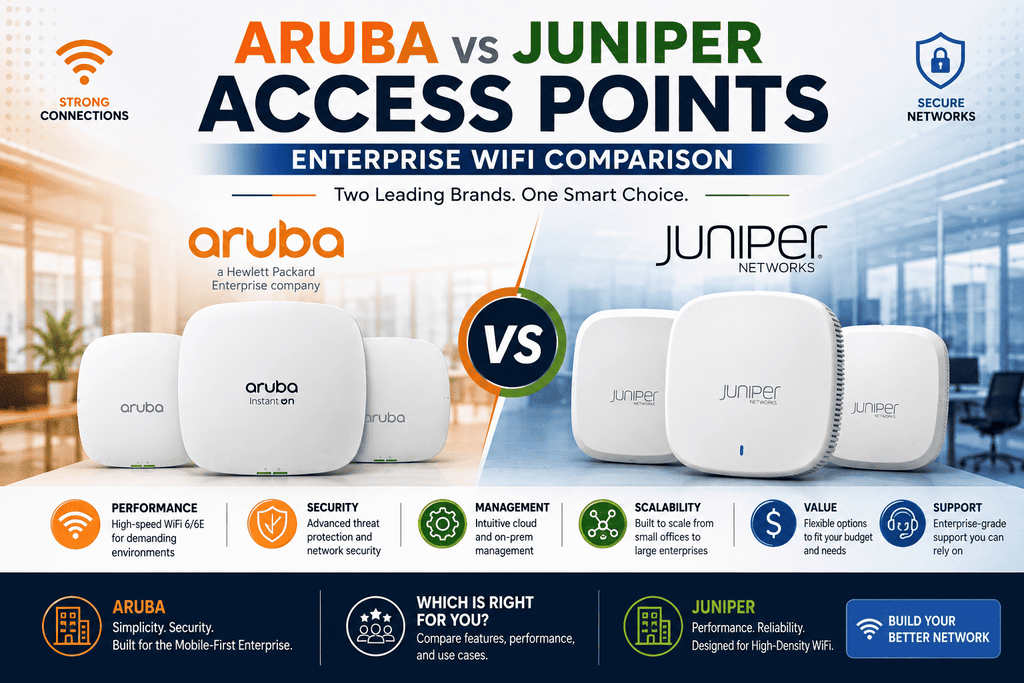
When assessing enterprise wireless access points, Aruba and Juniper Mist stand out as two highly esteemed brands; however, the comparison has evolved significantly in recent years. In July 2025, HPE finalized its $14 billion purchase of Juniper Networks, establishing Aruba and Juniper Mist as sister product lines within the same parent organization, HPE. This does not render the comparison insignificant — the two platforms possess unique hardware, software ideologies, and advantages — yet it alters your perspective on the decision-making process. Here is the essential information you require.
The Context of Ownership Precedes
HPE completed its acquisition of Juniper Networks on July 2, 2025, unifying HPE's Aruba Networking campus-edge platform with Juniper's cloud, data center, and service provider routing and switching portfolio, including Juniper's Mist cloud stack.
HPE has folded both product lines into a single HPE Networking division led by Juniper's former CEO, Rami Rahim, and is running the Aruba and Juniper brands in parallel depending on customer segment.
HPE is currently running Aruba Central and Juniper Mist as parallel management platforms, and the two are expected to coexist for at least 24 to 36 months while HPE gradually converges them, with Mist likely setting the long-term AI direction.
Newer Wi-Fi 7 access points already work with both Aruba Central and Juniper Mist, which HPE frames as protection against platform lock-in — you can buy new hardware today without committing to a single cloud-management ecosystem.
In short: this is no longer a competitive "pick a winner" comparison between rival vendors. It's a comparison between two engineering philosophies and management platforms that HPE is actively merging.
Flagship Hardware Comparison: Aruba AP-755 vs Juniper AP47 (Wi-Fi 7)
At the high end, HPE Aruba's AP-755 and Juniper's AP47 are the current flagship Wi-Fi 7 access points from each line.
HPE Aruba AP-755:**
- Requires AOS 10 and is cloud-managed exclusively through HPE Aruba Networking Central; it does not support legacy on-premises ArubaOS 8 controllers.
- Maximum power draw is 51 watts on single PoE or 53.9 watts with dual PoE enabled, and it requires Class 3 PoE to stage, with Class 6 (802.3bt) needed for unrestricted feature availability.
Juniper Mist AP47
- A tri-radio, 4x4, 12-spatial-stream access point with support for ultra-wideband, dual Bluetooth radios, dual 802.15.4 radios, one USB port, and dual 10-gigabit Ethernet ports with dual PoE capability.
- Supports Wi-Fi 7 with 320 MHz-wide channels in the 6 GHz band and 4K QAM modulation, plus built-in GNSS/GPS and simultaneous operation across the 2.4, 5, and 6 GHz bands.
- The dual Ethernet ports support several configurations — single uplink, dual uplink, or separate uplink/downlink connections — which is useful for infrastructure resilience in mission-critical deployments. *
- The AP47 is Mist cloud-managed only, with no published on-premises or standalone management mode — a consideration for organizations with air-gapped or data-sovereignty requirements.
Practical takeaway: - The AP47 leans harder into IoT and location-services hardware (UWB, GNSS, dual IoT radios), which reflects Juniper Mist's long-standing focus on asset tracking and location analytics. The AP-755 leans on Aruba's traditional strength in enterprise-grade RF performance and integration with the broader Aruba security and access-control ecosystem (ClearPass, Aruba Central policy management). ## Mid-Tier Comparison: Aruba AP-655 vs Juniper AP45 (Wi-Fi 6E)
For organizations not yet ready to move to Wi-Fi 7, both vendors' Wi-Fi 6E flagships remain solid, mature options. Both are compared on 6 GHz radio architecture with 160 MHz channel support, 802.11ax OFDMA and MU-MIMO, IEEE 802.3bt Class 6 PoE requirements, and FIPS 140-2/140-3 validation status.
Note that moving from Wi-Fi 6E to Wi-Fi 7 is a hardware replacement, not a firmware upgrade — the radio silicon and antenna arrays are generation-specific — though existing controllers and Cat 6A cabling from a Wi-Fi 6E deployment are generally sized appropriately for a future Wi-Fi 7 refresh. ## Management Platform: Aruba Central vs Juniper Mist AI
This is where the real differentiation still lives, at least for now.
Juniper Mist AI
has built its reputation on AI-driven operations. Mist's AI engine, Marvis, is designed to provide seamless connectivity, strong security, and simplified deployment through proactive, AI-driven troubleshooting. Reviewers frequently note that Juniper Mist holds an edge in AI-driven capabilities and detailed network analytics compared to Aruba's Instant management approach.
Aruba Central
has traditionally emphasized centralized visibility, scalability, and policy control across large, multi-site deployments. Aruba access points are often considered a strong choice when centralized cloud management, solid roaming performance, and strong analytics across multi-site networks are priorities.
HPE is actively cross-pollinating features between the two platforms rather than keeping them siloed. Mist's Large Experience Model — which uses app-aware telemetry from tools like Zoom and Teams to detect video-quality issues — is being brought into Aruba Central, while Aruba's anomaly-detection and root-cause-reasoning engine is being brought into Mist.
HPE has already moved Juniper's Large Experience Model and Marvis Actions microservices into Aruba Central, alongside two Aruba-originated AI features, with the goal of closing the gap toward a genuinely self-driving network with fewer trouble tickets. ## What This Means for Your Buying Decision
Given the merger, the calculus shifts from "which vendor is better" to "which platform fits my environment today, knowing both are converging over time." A few practical considerations:
- If you value AI-driven troubleshooting and analytics right now, Juniper Mist currently has the more mature AIOps engine, though Aruba Central is rapidly gaining equivalent capabilities.
- If you're already invested in the Aruba ecosystem** (ClearPass, Aruba switching, existing Aruba Central licensing), staying on Aruba hardware avoids disruption while you wait for platform convergence.
- If data sovereignty or air-gapped management matters**, check current documentation carefully — some Juniper Mist access points, like the AP47, are cloud-managed only with no published on-premises mode, while Aruba's AOS 10 platform is also cloud-first but has a longer history of enterprise/government deployment options worth confirming for your specific compliance needs. * **Avoid new investment in HPE Instant On.
- The DOJ-mandated divestiture of Aruba Instant On is still unresolved, and its future ownership is unclear, making it a risky choice for new deployments.
- Expect a multi-year transition. With both platforms expected to run in parallel for two to three years, buying decisions made today should factor in eventual migration to whatever unified platform HPE settles on. ## Bottom Line
Aruba and Juniper Mist access points are no longer competitors in the traditional sense — they're sibling product lines inside HPE's networking portfolio, each with real hardware and software strengths, being deliberately merged over the next several years. Juniper Mist currently holds an edge in AI-driven operations and location/IoT-focused hardware, while Aruba brings deep enterprise security integration and a long track record in large-scale campus deployments. For most buyers, the right choice today depends less on picking a "winner" and more on which ecosystem you're already invested in, and how comfortable you are riding out HPE's platform convergence roadmap.