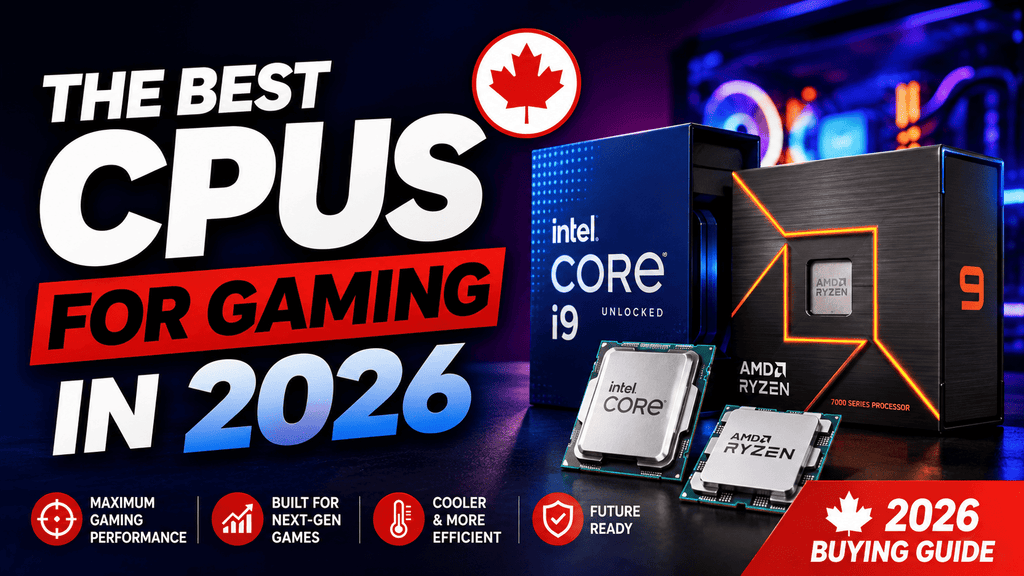
The best CPUs for gaming in 2026
The market for gaming CPUs has reached one of its clearest points in years: AMD's 3D V-Cache chips offer the best gaming performance across almost all price ranges, while Intel's main areas of competition are productivity-heavy workloads and mid-range value. This shows how things stand out based on price and use case.
The best overall: AMD Ryzen 7 9800X3D
Major hardware publications have tested both processors and found that the Ryzen 7 9800X3D is consistently faster than Intel's Core Ultra 9 285K in 1080p gaming frames per second (FPS) when the CPU is limited. The difference gets bigger in games that depend a lot on the CPU. For example, one popular benchmark shows that the 9800X3D is about 28% faster than the 285K in a strategy game that relies a lot on the CPU, but only about 18% faster in a game that relies more on the GPU.
It's not just the 9800X3D's speed that makes it the best choice; it's a mix of things. It works well enough with a mid-range tower cooler instead of needing high-end cooling, and AMD has promised to support the AM5 platform until at least 2027. Zen 6 will be available later that year. Its main weakness is multithreaded productivity work—an 8-core chip can't keep up with 16-core options if you regularly render video or compile large codebases, but for gaming, there aren't many chips that can compare.
The higher-end alternatives
- The Ryzen 7 9850X3D is a newer version with a faster boost clock that gives you a small performance boost in games compared to the base 9800X3D. Most reviews agree that the improvement is real, but it's not very big. For most buyers, the standard 9800X3D is still the better deal.
- If you want both top-notch gaming speed and real workstation-class productivity power, the Ryzen 9 9950X3D is the chip for you. It has 16 cores and 32 threads, as well as the same 3D V-Cache advantage. It's a real "do everything" processor for streamers, content creators, or pros who also play games seriously, but if gaming is your only goal, the higher price isn't worth it.
- Intel Core Ultra 9 285K: Intel's top-of-the-line processor is better in some multithreaded productivity tasks and has more cores overall than AMD's game chips, but it doesn't have 3D V-Cache silicon to close the gaming gap.
The best mid-range picks
Intel Core Ultra 5 250K Plus: This chip is often called the best value on the market right now because it offers great gaming performance for about $220 and great productivity performance at the same time, which is not often found at this price.
There was some trouble with the launch of the AMD Ryzen 7 9700X, an 8-core, 16-thread Zen 5 chip, but firmware and OS updates have made it much better since then. It can handle GPUs up to about the RTX 4080/RX 7900 XT class without slowing down.
Ryzen 5 9600X and Intel Core Ultra 5 245K work well together with RTX 4060–4070 GPUs and are a good choice if you're not looking for top-of-the-line frame rates.Picks for budget
The Ryzen 5 7600X3D is a good low-end gaming processor thanks to its 3D V-Cache, but it's not as good for anything else because it only has 6 cores and slower clock speeds than its X3D brothers.
If you need to use an existing AM4 motherboard and DDR4 memory, you should know about the Ryzen 7 5700X3D. It's the only current gaming chip that's still available for that older, cheaper platform.Matching the level of CPU to GPU
People often make the mistake of putting a powerful GPU with a slow CPU or spending too much on a CPU that your GPU can't keep up with. As a general rule:
For GPUs in the RTX 4060–4070 class, Ryzen 5 9600X or Intel Core Ultra 5 245K is more than enough.
Mid-range to high-end GPUs (RTX 4080-class, RX 7900 XT): Ryzen 7 9700X can handle these without any problems.
For flagship GPUs like the RTX 5080, RTX 5090, and RX 9070 XT, the 9800X3D or 9950X3D really shines. Anything less can leave performance on the table.
Something to know about Intel's 13th and 14th-generation chips
If you're thinking about buying a Core i9-14900K or a similar 13th or 14th-generation Intel chip, whether it's new, used, or already owned, you should know that these generations had well-known problems with stability linked to voltage. Reviewers say that the issues can be fixed by updating the motherboard's BIOS and setting the right voltage limits. However, this is an important step that should be taken before using one of these chips seriously.
In the end
In 2026, AMD's 3D V-Cache series is the clear choice for gamers across almost all price ranges. The 9800X3D is at the top of the line, followed by the 9700X and 9600X in the middle, and finally the 7600X3D or 5700X3D at the bottom. Intel is still a good choice if you care about both work and gaming performance, especially with the Core Ultra 5 250K Plus at the low end. However, AMD's cache-heavy chips still beat Intel when it comes to pure gaming performance.
Benchmarks and prices are based on tests and market data from the middle of 2026. They will change as new chip generations, like Zen 6 and Intel's Nova Lake, get closer to launch, so make sure you know the latest prices and availability before you buy.