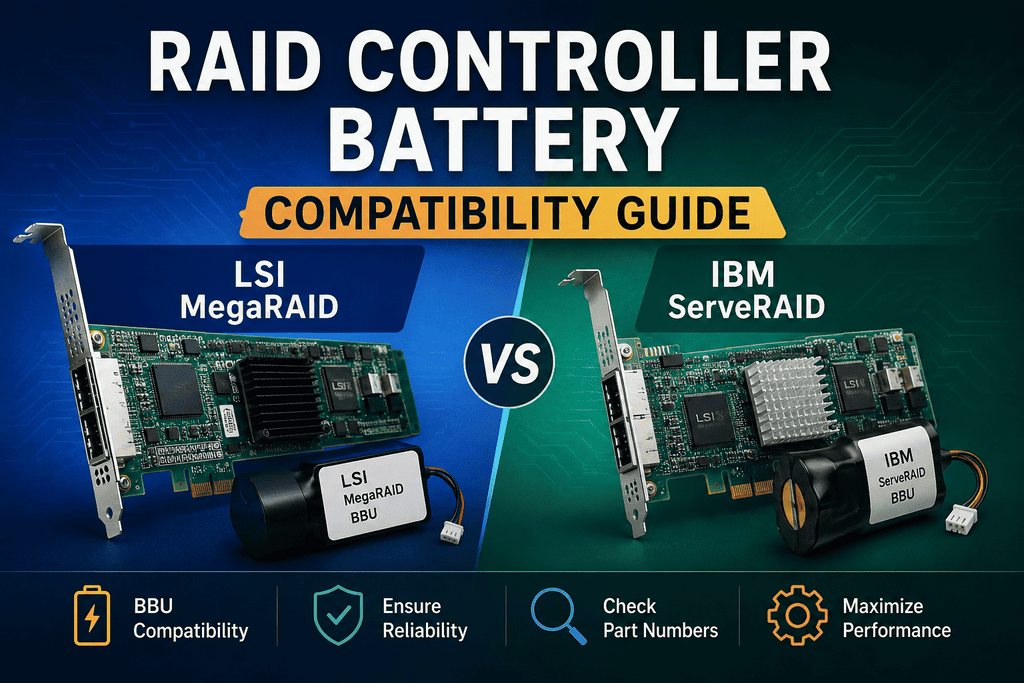
RAID Controller Battery Compatibility Guide: LSI MegaRAID vs IBM ServeRAID
RAID Controller Battery Compatibility Guide: LSI MegaRAID vs IBM ServeRAID
Selecting the incorrect supercap module or battery backup unit (BBU) for a RAID controller might result in actual data loss in the event of a power outage, reduced array performance, or write-back cache being disabled. In order to help you choose the right component before making a purchase, this document explains battery compatibility for two of the most popular RAID controller families in enterprise servers: IBM ServeRAID and LSI (Broadcom) MegaRAID.
Why RAID Controller Batteries Matter
A battery or capacitor pack is employed by RAID controllers with integrated cache to safeguard data that is stored in volatile memory during a power outage. In the absence of a functioning backup unit:
The controller typically reverts to write-through mode, which is significantly slower than write-back.
Data that has been cached but has not yet been written is susceptible to vulnerability during disruptions.
Until the battery is replaced or disabled in the configuration, certain controllers generate persistent BIOS/firmware alerts.
Replacement of these batteries and supercaps is a routine maintenance task due to their degradation over a period of 2–4 years of service. However, this is contingent upon the correct unit being matched to the appropriate controller generation.
LSI MegaRAID Battery Compatibility
LSI (now under Broadcom) has shipped several generations of backup technology, and they are not interchangeable across generations.
iBBU (Intelligent Battery Backup Unit)
Used on older MegaRAID cards (SAS 8xxx and early 9xxx series). These are lithium-ion battery packs that connect via a ribbon cable directly to a header on the controller board.
BBU07 / BBU09
Common on mid-generation MegaRAID SAS cards (9260, 9265, 9271, 9280 series). These use a battery pack mounted either directly on the card or via a remote mount bracket and cable, depending on chassis clearance.
CacheVault (CVPM / CVPM02)
Introduced with the 12Gb/s MegaRAID lineup (9361, 9380, 9460, 9560 series), CacheVault replaced batteries with supercapacitor modules. Supercaps don't suffer the same wear-out and memory-effect issues as lithium batteries, and they support flash-backed write cache (FBWC), which dumps cache contents to NAND flash rather than holding it in DRAM indefinitely.
Key compatibility rule: The battery/supercap type is tied to the specific controller model, not just the "MegaRAID" brand name. Always cross-reference the exact controller model number (printed on the card, or viewable via MegaCli / StorCLI) against the vendor's compatibility matrix before ordering.
IBM ServeRAID Battery Compatibility
IBM ServeRAID controllers (many of which are OEM'd LSI silicon under the hood, later carried forward under Lenovo) have their own part numbering, which does not map 1:1 to LSI's retail part numbers even when the underlying chipset is shared.
ServeRAID M-series (M1015, M5014, M5015, M5016, M5025)
These use IBM-specific battery backup units — commonly referred to by IBM FRU numbers rather than LSI BBU numbers. Even though the M5015, for example, is built on an LSI SAS2108 ROC, the physical battery module and its connector/cable assembly are IBM-branded and should be sourced by IBM FRU part number for guaranteed fit.
ServeRAID M5100 / M5200 Series
Later ServeRAID cards moved to a flash-backed cache design similar to LSI CacheVault, pairing a supercapacitor with onboard NAND flash. This is IBM's equivalent shift away from battery-based backup.
Key compatibility rule: Always match by IBM FRU/option part number, not by physical resemblance to an LSI battery. Cables, connector orientation, and even battery chemistry can differ between an IBM-branded unit and its closest LSI counterpart.
LSI vs IBM: Are the Batteries Cross-Compatible?
| Factor | LSI MegaRAID | IBM ServeRAID |
|---|---|---|
| Part numbering | LSI/Broadcom BBU/CacheVault part numbers | IBM/Lenovo FRU/option numbers |
| Physical interchange | Sometimes, on shared-chipset cards | Rarely reliable — confirm FRU match |
| Supercap generation naming | CacheVault (CVPM/CVPM02) | Flash-backed cache module (similar design, different FRU) |
| Sourcing | LSI/Broadcom compatibility matrix | IBM/Lenovo ServerProven list |
Bottom line: even when an IBM ServeRAID card uses the same underlying LSI RAID-on-Chip (ROC) as a retail MegaRAID card, treat the battery as a separate compatibility question. The safest approach is always to identify the exact controller model and pull the specific battery/supercap part number from the manufacturer's official compatibility documentation — not to assume a physical or generational match will work.
How to Identify Your RAID Controller Battery Requirement
-
Find your controller model. Check the physical card silkscreen, server BIOS/UEFI RAID utility, or run the vendor CLI tool (
storcli /c0 showfor LSI/Broadcom, or the equivalent IBM/Lenovo management utility). - Check whether it's battery-based or supercap-based. Cards from roughly 2013 onward increasingly shipped with CacheVault/flash-backed cache instead of a lithium battery.
- Cross-reference the exact part number against the manufacturer's official support matrix or FRU parts list before purchasing a replacement.
- Verify the cable and mounting bracket, not just the battery/cap pack itself — mismatched cables are a common source of "compatible battery, wrong connector" returns.
Signs Your RAID Battery Needs Replacement
- BIOS/POST or controller management software reports "Battery Needs Replacement" or a relearn failure
- Write-back cache automatically switches to write-through
- The battery is more than 2–3 years old (typical lithium-ion service life for iBBU/BBU07/BBU09 units)
- Physical swelling or visible damage to the battery pack
Final Recommendation
Because LSI MegaRAID and IBM ServeRAID batteries follow separate part-numbering systems even on shared hardware, don't shop by "looks like the same battery." Always confirm compatibility using the exact controller model number against the current manufacturer compatibility matrix (Broadcom's for MegaRAID, Lenovo/IBM's ServerProven documentation for ServeRAID) before purchasing a replacement battery or supercap module.