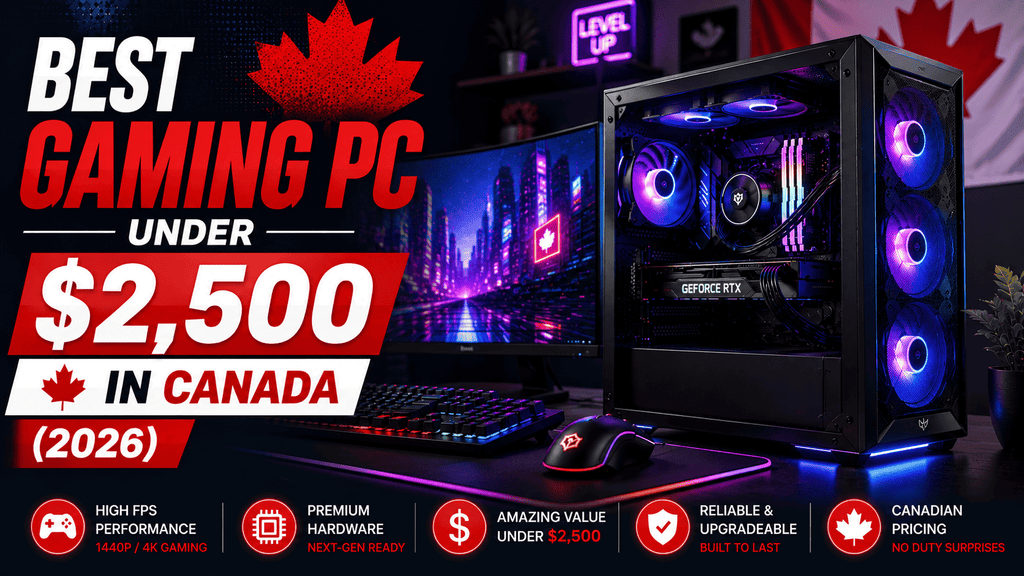
Best Gaming PC Under $2,500 in Canada (2026)
Around $2,500 CAD, "high-performance" stops being a catch-all term. Compared to the $2,000 tier, you don't have to choose between a faster CPU and more RAM; at this price point, you can expect both, plus a GPU that can handle 1440p without any problems and goes up to 4K in many games. If your budget allows it, this is the range that serious gamers should aim for.
What $2,500 should get you
- GPU: RTX 5070 Ti or Radeon RX 9070 XT if fast rasterization is more important to you than ray tracing and DLSS.
- CPU: Ryzen 7 9800X3D or 9700X, Ryzen 9 series, or a current Intel Core i7/Ultra 7
- RAM: 32GB DDR5, no longer a stretch goal at this price
- Storage: 2TB Gen4 NVMe SSD, with Gen5 drives starting to show up in builds at this tier
- Cooling: This is the point where better case airflow and higher-end AIO coolers (240mm+) become normal, not an add-on.
You can expect 144+ frames per second in e-sports games without any drops, 60–100+ frames per second in challenging AAA games at 1440p, and truly smooth 4K in well-optimized games, especially when DLSS 4 or FSR upscaling is used.
NVIDIA vs. AMD at this tier
This is one of the more genuine either/or decisions in the current market:
- If you care about ray tracing, DLSS 4 with Multi Frame Generation, or doing any streaming, content creation, or AI-related work along with gaming, the NVIDIA RTX 5070 Ti is the better overall choice. This is because NVIDIA's software ecosystem is more developed in these areas.
- The AMD RX 9070 XT is often the better value for pure rasterization. It offers better performance per dollar in games that don't rely too much on ray tracing and costs less than the 5070 Ti.
Neither is a wrong choice at $2,500. Base it on whether you actually use ray tracing/DLSS-dependent features, not on brand loyalty.
Where the money should actually go
At $2,500, the GPU should still be the priority component — resist the temptation to over-invest in CPU, RGB, or case aesthetics at its expense. A well-balanced build looks like:
- GPU gets the largest single share of the budget
- CPU is strong enough not to bottleneck the GPU (a 9800X3D or equivalent won't), but doesn't need to be the absolute flagship
- 32GB RAM and 2TB storage are treated as standard, not upsells
- The PSU and cooling are sized properly for the GPU's actual power draw — at this tier, that typically means 850W 80+ Gold and a real AIO or high-end air cooler, not the cheapest unit that technically fits the wattage spec
Watch for this at $2,500
This is a common price point for marketing, so you'll see some builds that aren't quite what they seem to be. For example, an RTX 5070 Ti might be advertized with a CPU or cooler that only has one fan to get a high top price. It's not just a matter of looks; an underpowered AIO on a high-draw CPU can lead to thermal throttling under sustained load, which shows up as stuttering in games that use a lot of CPU power instead of just louder fan noise. Check the cooler model and CPU that go with it, not just the GPU that is being promoted.
How this compares to neighbouring tiers
When you drop the price to $2,000, you mostly have to trade in the 5070 Ti for a 5070 or 5060 Ti, which are still very powerful but have less room for 4K and ray-tracing. Stepping up to $3,000+ moves you toward RTX 5080 territory, where 4K becomes the comfortable norm rather than an occasional bonus. If your monitor is 1440p, $2,500 is close to the point of diminishing returns — spending more mainly buys resolution and ray-tracing headroom for a future upgrade rather than performance you'll use today.
The specs and prices are based on the Canadian retail market as a whole in the middle of 2026. GPU pricing and availability shift often at this tier, so check current specs and pairing before buying.